
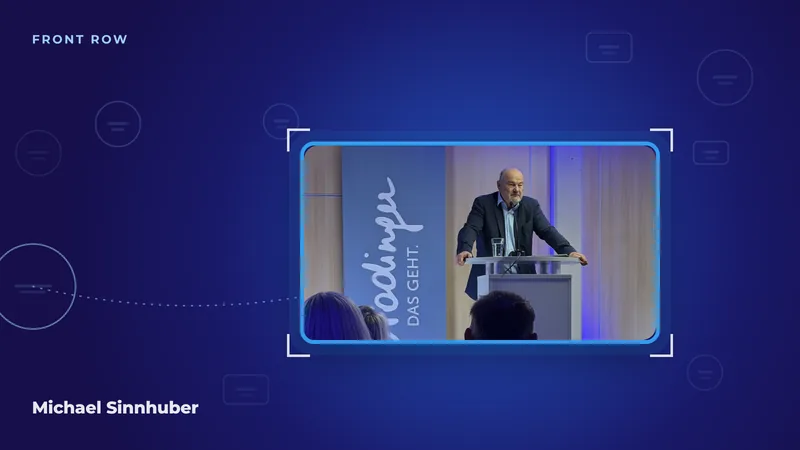
Every now and then I come home from a talk and I’m simply blown away. November 5, 2026 was one of those nights. Dr. Thomas Müller, one of Austria’s best-known criminal psychologists, spoke about fear for 75 minutes in Zell am See, without a single slide. I could have listened for hours.
The evening was hosted by Prodinger, a tax and business consulting firm, for a small group of invited guests. Thank you for having me. It was a real pleasure and an honor to be there.
Nights like this teach me as much as the big TED Talks do, so I’m starting a new series called Front Row. In it, I write about talks I’ve watched in person, from the audience, and what you can take from them for your own presentations.
The talk at a glance
| Speaker | Hon.-Prof. Dr. Thomas Müller, criminal psychologist and profiler from Innsbruck, Austria |
| Title | “Keine Angst vor der Angst” (No Fear of Fear), part of the “Herbstgespräche 26” series |
| Host | Prodinger tax and business consulting |
| Where and when | Zell am See, Austria, November 5, 2026 |
| Length | about 75 minutes |
| Slides | none |
From 1993, Müller built up the criminal psychology service at Austria’s Ministry of the Interior. Among the people who trained him was FBI profiler Robert Ressler. In the German-speaking world, he’s also known for books such as “Bestie Mensch”.
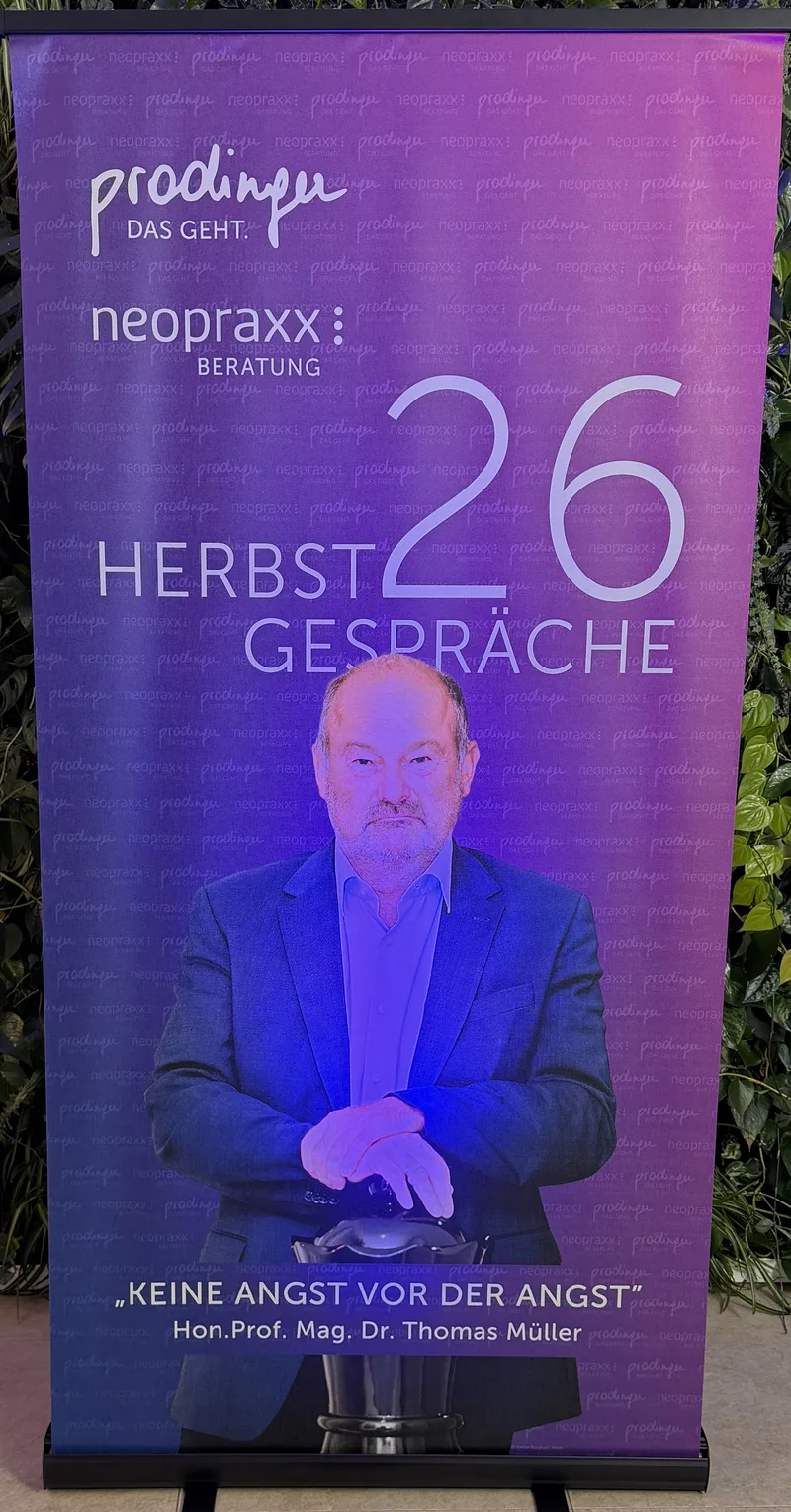
The opening: playing at home
Before Müller took over, his hosts gave an introduction. It was supposed to be short. It ran to about 15 minutes. Müller picked up on that right away and, with a grin, reminded the room several times that he’d been promised a quick intro. People laughed, and the ice was broken.
Then he told the audience this was a home game for him. Being from Tyrol, he could talk the way he does at home, and everyone would still understand him. And that’s exactly how he spoke for the rest of the night: easy to follow, with an unmistakable Tyrolean accent.
That’s more than a nice touch. In my House of Speaking method, everything starts with the foundation, and a big part of that is being yourself on stage. Müller doesn’t put on an act. He talks the way he talks, and that’s exactly why you want to keep listening from his very first sentence.
Your turn: Next time you present, notice how you speak. If you’re putting on a stage voice, try your everyday language instead, the way you’d talk to a colleague.
The question that frames it all
Müller opened the topic with a paradox. Statistically, the world has never been safer than it is today. Yet more people than ever suffer from fear. A very subjective kind of fear, as he pointed out.
Then he asked everyone to think of their own three biggest fears and keep them in mind. Over the course of the evening, we’d look at those fears from several angles, around six in all, from a playful one to a medical and psychological one. And he made a promise: if you look at your fears from all these perspectives, they get smaller.
That’s a smart move. With one simple request, he pulls every single person in the room into the topic, without anyone having to raise a hand or say a word. And his promise answers the question every audience is silently asking right from the start: What’s in it for me?
Stories instead of slides
The whole talk was packed with stories and anecdotes. Two of them stuck with me.
The first came from his work with people on the verge of taking their own lives. Early on, he said openly, he failed with many of them. Then, in one decisive case, he changed the way he approached the conversation, and it worked. He hasn’t lost a single person since. It’s hard to think of a stronger way to show the power of a personal conversation.
The second story was about a doctor friend of his. Brilliant at medicine, Müller said, but with the social skills of a microphone. The doctor called him because a long-time patient had screamed at him, and he had no idea why.
The backstory explained everything. The patient had come in on a Thursday to find out whether she had a serious illness. The doctor promised to call her the next day. She was so anxious that she stayed home from work on Friday and waited by the phone all day. The call never came. Over the weekend, the uncertainty turned into anxiety, and the anxiety turned into anger. On Monday morning she called the practice herself. First the doctor wasn’t in yet, then he was with someone. When she finally got him on the third try, it all came pouring out. His response: everything’s fine, you’re healthy, why are you so upset?
So Müller asked him a question. What if your daughter went to a music festival, promised to be home at a certain time and then didn’t get in touch for two days? And on the third evening, she walks through the door? He’d lose it, the doctor said, because he’d have been worried sick. And what if she then told him to calm down, because everything was fine anyway? That’s when the doctor finally understood his patient.
This story is a masterclass in perspective taking. Müller doesn’t lecture his friend about what he did wrong. He takes him into a situation from his own life where he’d feel exactly the same way. You can use the same technique in any presentation. When your audience doesn’t get a point, find a moment from their own lives where they’ve felt the same thing.
Your turn: Take the key message of your next presentation and ask yourself when your audience has experienced something like it themselves. Tell that story before you make your point.
The biggest fear
At one point, Müller turned to men’s biggest fear. He built up to it brilliantly, first listing a whole range of fears that weren’t the biggest. The suspense grew with every remark. Then came the reveal. It’s the fear of speaking in front of a crowd.
I had to smile, because that’s exactly what I cite in my book “3, 2, 1… Reden ist jetzt Deins”. In a 2013 survey in Germany, 41 percent of respondents named speaking in public as their biggest fear. Only 19 percent said illness and death. A well-known American survey by Bruskin Associates had already found similar numbers back in 1973, and in 2012 researchers at the University of Nebraska Omaha revisited the question with college students and largely confirmed it. Whether it ranks first, second or third, a huge number of people share this fear. And the man talking about it was standing in front of a crowd himself, showing how it’s done.
Freedom, security and living with fear
Müller shared far more ideas than I could keep track of. These are the ones that stayed with me:
- Freedom and security. Everyone wants both, but they sit at opposite ends of the same scale. If you want more of one, you have to give up some of the other. We live in a world that offers more freedom than ever and is safer than ever. And yet fear is everywhere.
- Fear matters. Without fear, we wouldn’t survive two days. The real question is how much subjective fear we let in and how we learn to deal with it.
- Face it. Pushing problems away only makes them bigger, and the fear along with them. His advice, in essence: face the problem, analyze it, make a decision. Now, not someday.
- Imagining it takes longer than doing it. A termination meeting is over quickly. The thoughts a manager churns through beforehand can go on for days or weeks.
I see that last point all the time in my coaching. A presentation works exactly the same way. The talk lasts 20 minutes, but the worrying beforehand can go on for weeks. The sooner you face your talk and prepare for it, the shorter that stretch becomes. More on that on the stage fright page.
Delivery: variety from behind a lectern
Müller stood at a lectern all evening. Plenty of public speaking advice warns against that, because a lectern puts a barrier between you and the audience. In his case, it simply didn’t matter, because he used everything else a voice can do:
- loud and soft
- fast and slow
- deliberate pauses
- humor running through the entire evening
The audience never had a chance to settle into a pattern. There wasn’t a single second when you didn’t want to listen. I described the same principle in my breakdown of Salman Khan’s TED Talk, except that Khan moves around the whole stage. Müller proves it works standing in one spot, as long as the content and the voice are right.
When he quoted figures from studies, by the way, he didn’t name his sources. In a coaching session, I’d normally point that out. Here, nobody minded. People simply believed him, because his experience speaks for itself.
Design: not one slide
In the next episode of Talk Breakdown, you’ll meet Lawrence Bernstein, who gets by with a single slide in his TEDx Talk. Thomas Müller didn’t need any. For 75 minutes, the audience had nothing to look at but him and the pictures his stories created.
Design is the third phase of the House of Speaking method, and this evening shows what it’s really about. Slides should amplify your message. If your stories already paint the picture, every slide is one too many. Müller held his through-line together with the promise he made at the start and a short recap of his key points at the end.
That doesn’t mean you should ditch your slides tomorrow. But it’s worth asking of every slide whether it shows something your words can’t.
The close: a laugh that lands
Just before the end, Müller summed up his main points in a few sentences. Then he closed with a story about an email exchange he’d had before the talk with one of the guests, without naming him. The punchline: that guest was probably now too scared to out himself when it came time to get his book signed.
A brilliant way to finish. Funny, light and still right on topic. People walked out laughing, with the message firmly in their heads.
My takeaway from the evening
Müller made many powerful points. For me, they come down to one idea. Courage isn’t the absence of fear. It’s facing your fears deliberately and then doing the thing anyway. That’s my summary, not a direct quote. But it’s exactly what he showed that night, in what he said and in how he said it.
Claudia Sima of Lebensgefühl, a life and social counselor who came with me and followed the talk more from a psychological angle, was every bit as impressed as I was.
Further reading
After the talk, Müller explained what each of his two books is about. Both are in German:
- “Bestie Mensch. Tarnung – Lüge – Strategie” (roughly: The Human Beast. Disguise, Deception, Strategy) draws mainly on his perspective and experience as a criminal psychologist.
- “Gierige Bestie. Erfolg – Demütigung – Rache” (roughly: The Greedy Beast. Success, Humiliation, Revenge) is closer to what he talked about that evening.
What you can take into your next talk
- Be yourself. Speak the way you speak, accent and all, as long as everyone can follow you.
- Make it personal for your audience. A request like “Think of your three biggest fears” beats any statistic.
- Tell stories. Ideally ones your audience can see themselves in.
- Use perspective taking. Put your audience in a situation where they feel the same thing themselves.
- Keep it varied. Loud and soft, fast and slow, pauses and humor.
- Question every slide. Each one has to show something your words can’t.
- Recap, then end on a light note. A short summary and a closing that makes people smile will stick.
And if fear of public speaking sits at the top of your own list, face it. In public speaking coaching, we tackle it together, one step at a time.
Frequently asked questions
Can you give a long talk without any slides?
Yes, as long as your through-line is clear and your content is carried by stories. Slides are there to amplify your message. If your stories already paint the picture, you don’t need them. Building a talk that way is part of coaching for presentations and talks.
Is public speaking really people’s biggest fear?
For a lot of people, yes. In a 2013 survey in Germany, 41 percent named speaking in public as their biggest fear, compared with 19 percent for illness and death. Whether it ranks first, second or third, it’s one of the most common fears there is, and you can get it under control. Here’s how: stage fright.
How do I deal with fear before a presentation?
Face it instead of pushing it away. Pin down exactly what you’re afraid of, then decide what you’re going to do about it. Thinking about a talk usually takes up far more time than the talk itself, and good preparation shortens that stretch. More in my book “3, 2, 1… Reden ist jetzt Deins”.
Is it okay to speak with an accent or dialect on stage?
Absolutely, as long as everyone can follow you. Speaking the way you normally do makes you approachable and believable. The moment you try to sound like someone else, you stiffen up. Why that matters so much is the foundation of my House of Speaking method.